Captured images of God's amazing creation!

Tuesday, October 11, 2016

The North American Nebula (NGC7000):

In June 2016 I set out on a mission to image NGC7000, The North American Nebula, from my front yard in St. Ann's. It's dim, in our light polluted skies, so I was sure this would take a few nights to gather enough exposure time. I ended up shooting on six different moon-free nights through-out the summer and gathered over 14 hours of exposure! After my last shooting session on Sep 6th I went through all the frames manually and deleted 4.5 hours of imperfect frames. I then allowed Deep Sky Stacker to eliminate another 10% automatically. This made a nice hi-res, low-noise, 8.5 hour image to process.
Lesson learned: The last few nights of shooting, I had to flip the view as my target crossed the Meridian! What I didn't think about, was that the diffraction spikes on the larger stars would not match with the spikes from all my previous shots. Fortunately, the spikes ended up 45 degree offset from the original view, so it looks like I did it on purpose!
The image is 102 x 5 minute frames (8.5 total hours) @ 1600iso shot in June, July, August and September (20 flats, 20 darks and 20 offsets) with a 8 inch F5 Skywatcher Newtonian and a Canon T3i (modified) with coma corrector and LP filter.
This has been my favourite image to process thus far! The detail and natural colour amaze me. It's incredible, what appears to be a black sky, is actually so full of colour and artistry.
"God's creation" is specifically referred to in 314 verses thru-out scripture! I believe it is wise to give Him full credit for all of creation, and then allow science to fit into the cracks!

Thursday, July 28, 2016

M42 Orions Nebula

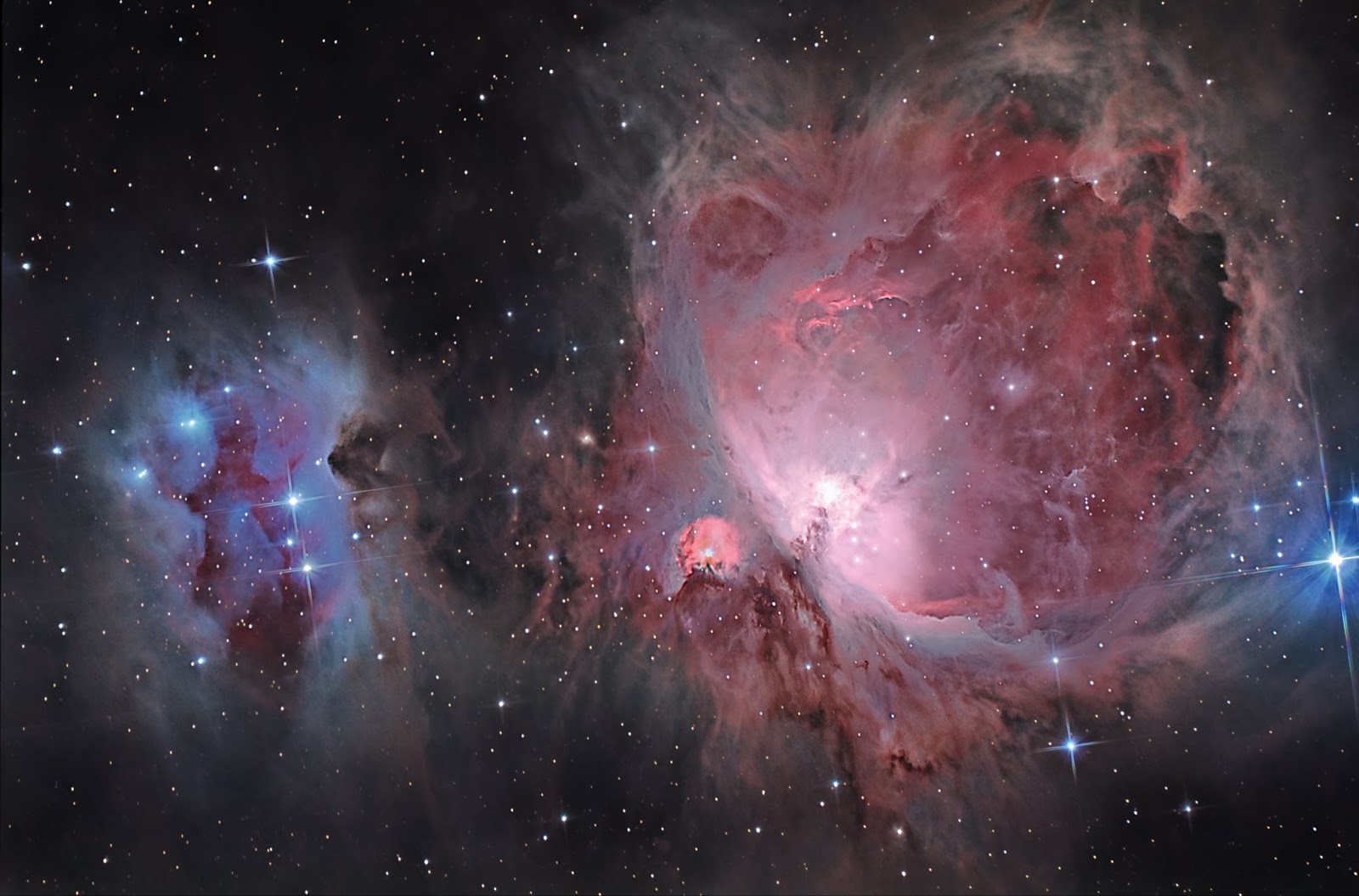
My winter and spring 2016 project was imaging and processing "M42" and the "Running Man", both found in the constellation Orion. This deep-sky object receives so much attention because it is so large, bright and beautiful. 
The heavens declare the glory of God; the skies proclaim the work of his hands. Ps19:1
M42 - Approximately 5 hours exposure, Winter 2016

Saturday, August 15, 2015

July’s Nebulae:

I was blessed with two beautiful clear nights around July’s new moon to shoot some classic sky gems!
The Eagle Nebula (taken from our front yard) is an emission nebula in the constellation Serpens about 7000 light years away. The second image is the Western Veil Nebula (shot from the east side of Algonquin Park), a supernova remnant in the constellation Cygnus at only 1470 light years from earth. I shot the East side of the veil 2 years ago so I was happy to complete the pair!
The day I shot the Veil I noted my Bible app “verse of the day”: Ah, Sovereign Lord, you have made the heavens and the earth by your great power and outstretched arm. Nothing is too hard for you. (Jer 32:17)
The Eagle Nebula (M16) - 2.5 hours total exposure
The Western Nebula - 4 hours exposure under light polution free skies


Monday, February 23, 2015

IC434 The Horse Head Nebula & NGC2024 The Flame Nebula:

Despite the extreme cold weather this winter, I was able to brave the elements on January 15th – It only bottomed out at -11c (at 2am in St. Ann’s).
The bright eastern ‘belt’ star in Orion (named Alnitak) is surrounded by these deep sky treasures: The Horse Head and Flame Nebula.
The trick is exposing them with long exposure photography, without blowing out your picture with the strong blue glow of Alnitak!
Careful processing tricks allow you to isolate the bright star glow while teasing out the detail of neighboring dim nebulosity! 3 hours of exposure and almost 4 hours of Photoshop processing went into this image. Ethical processing must respect and maintain the images natural colour and detail. I like to show it the way it was intended to be seen! As you can guess, I admire the Creator and the detail in His artwork!
If you search the internet for Hubble images of the Horse Head Nebula you will be blown away by the detail captured from Hubble!

53 sub frames @ 3.5 minutes each = 3 hours, 5 minutes and 30 seconds total exposure @ 1600 ISO

Wednesday, November 5, 2014

The Pleiades

The Pleiades (or Messier 45) is an open star cluster of middle-aged 'hot' stars located in the constellation of Taurus. This middle-aged 'hot' astronomer has been wanted to shoot the Pleiades since I purchased my 8" Newtonian telescope 3 years ago. The 'field-of-view' native to my scope nicely frames this beautiful star cluster with all it's blue wisps of star-lit nebulosity. The image below is the sum total of 3 hours exposure.
Other than Orion and the Big Dipper, the Pleiades is the only starry object in the sky that God references in the Bible! My favorite is when he questions Job's doubt in Job 38:31 below (it's a message that seems like it was written specifically for me):  
Job 9:9 - He made all the stars—the Bear and Orion, the Pleiades and the constellations of the southern sky.
Job 38:31 - “Can you direct the movement of the stars— binding the cluster of the Pleiades or loosening the cords of Orion?
Amos 5:8 - It is the Lord who created the stars, the Pleiades and Orion. He turns darkness into morning and day into night. He draws up water from the oceans and pours it down as rain on the land. The Lord is his name!
...Consider the size of this star cluster at 16 light years (left to right)... or 160 trillion kilometers! God simply bound (or connected) it's stars together in the palm of His hand! It's another great example of his magnificent art work and power!
 

M45 "The Pleiades" - 60 x 3 minute frames = 3 hours totsl exposure @ 1600 iso


Tuesday, October 28, 2014

The Andromeda Project (continued):


In September 2013 I posted the first picture from my "Andromeda Project".
 
The Andromeda Galaxy's apparent size is so large in the sky (about 5-6 moon widths across) that I am not able to fit much more than half of it in my telescopes imaging field. 

Last year I shot the "left side" and this September, I have completed the "right side".

I have now processed the two images and joined them together in Photoshop CS2!


The second shooting session was the result of a great weekend spent at the cottage just east of Algonquin Park! My brother and I escaped our normally busy lives to appreciate the best of what God has to offer in northern autumn hikes and undisturbed clear night skies! We had a blast and determined that this is now officially, an annual event! (Belly aches prevailed all weekend, caused by intense laughter and extreme over-eating!)

Note: I still owe this blog one more shot of the Andromeda Galaxy - I would like to shoot a wide field image to include neighboring constellation Cassiopeia (the "w" in the sky). I want to illustrate the position of this galaxy, so readers will look for it and find it. It's an easy object (under a dark sky) using binoculars or even the naked eye. I hope to complete this next fall.  

Wednesday, September 10, 2014

Hello everyone,  My blog has been getting a lot of traffic from Russia, Germany, USA, UK, France, and other countries. I would love to hear from you folks! Please feel free to comment (in English or your own language... I can use google translate!).
Thank you for your interest!
Greg

Tuesday, September 9, 2014

Astronomy Retreat:

Near the end of August, I travelled to Cherry Springs State Park, PA. Cherry Springs is a protected dark sky site with an astronomy field specifically for imaging and observing the night sky. http://www.dcnr.state.pa.us/stateparks/findapark/cherrysprings/

I had two amazing nights with great skies and lots of great conversations with fellow imagers and observers.

A skunk visited the field the first night! The people he visited reacted aggressively to his presence… He showed his disapproval by spraying their tent! “Ground-zero” (we’ll call it) was on the opposite end of the field, so I was fortunate to avoid most of the excitement.

The cloud from “Pepe Le Pew” soon dissipated and was replaced by beautiful star clouds. A beautiful cross-section of our galaxy hung straight over head at the beginning of the night and Orion was well up in the eastern sky by 4:30am. The forecast showed average ‘seeing’, but it was the best skies I have ever seen.

I imaged the Helix Nebula, a large planetary nebula located in the constellation Aquarius. Simply put, this nebula is a large, colorful, egg-shaped sphere of illuminated gases. From our vantage point, we look 30 degrees off its centre axis. This creates a bit of a 3D effect.

The Helix has been nicknamed “The Eye of God” so I entered that name in a bible search and came up with this solid truth: The eyes of the Lord are in every place, watching the bad and the good. (Proverbs 15:3)


Helix Nebula - 47 x 5min frames = 3 hours 55 minutes total exposure at 1600 iso
 

Thursday, July 3, 2014

THE TRIFID NEBULA:

I haven't been able to visit our club's dark-sky-location recently. But... I have managed to take one image from my front yard this summer. M20, the Trifid Nebula. It's such a beautiful combination of an emissions nebula (red), a reflection nebula (blue) and a dark nebula (in front of the red). It rests in a wide-open star cluster situated above the teapot's spout is Sagittarius (forming part of the steam from this boiling teapot). 

I acquired 92 good frames for a total exposure time of 5 hours and 22minutes. These frames were shot over 4 separate nights between the 19th and 28th of June.

I included a picture of my home set-up with Saturn in the background... well, my Saturn! I have the laptop in the camper so I can review the subs and monitor my guiding graph. The kids like the "camp-outs" in the trailer (it's family friendly astronomy)! 

My 10 year old boy helped polar align, 3-star align, focus and frame the Trifid. He first practiced his new astronomy skills by slewing to the Ring Nebula, The Dumbbell Nebula and the Great Hercules Cluster! He snapped 35 second, unguided shots of each... I'm very proud! All three kids are getting to know the night sky pretty well! We may have some budding astronomers!!! Ephesians 6:4 says "Fathers, do not exasperate your children; instead, bring them up in the training and instruction of the Lord". We take this verse very seriously... my astronomy training is an added bonus. We all agree, God is the Author and Artist who created the night sky!  
 
92 frames were stacked @ 3.5 minutes each = 5 hrs, 22mins (1600iso)

Thursday, February 20, 2014

Roses are Red!

It was so good to be back under clear skies at the beginning of February! Our weather patterns can be a challenge for an amateur astronomer! A few targets I hoped to shoot this winter have come and gone – but there’s always something on the horizon.

Just east of the Orion constellation lies NGC2244, The Rosette Nebula in the constellation Monoceros. The nebula’s diameter is 130 light years and it just fits into my telescope’s field-of-view @ the distance of 5200 light years from earth.

After the moon set around 10pm I was able to collect almost 3 hours of precious photons! It stayed clear all night and bottomed out at a manageable -12c.

Psalm 33:6  The Lord merely spoke, and the heavens were created. He breathed the word,  and all the stars were born.
NGC2244 The Rosette Nebula: 49 frames @ 3.5 minutes = 2hrs 51.5mins @ 1600iso taken February 3&4, 2014
 

Saturday, October 19, 2013

M31 The Andromeda Galaxy:

About The Andromeda Galaxy:
The closest Galaxy to our Milky Way is M31, The Andromeda Galaxy, only 2,500,000 light years away. Andromeda and our own Milky Way galaxy are speeding through space towards each other which will result in a catastrophic collision and subsequent reformation of a new giant elliptical galaxy. This is estimated to happen roughly 3.75 billion years from now… I guess it’s a little early to start building a backyard bunker.
It has recently been estimated that M31 holds about one trillion stars, more than double that of our home galaxy, which weighs in at 200-400 billion stars...

Contemplating Galaxies:
I have a hard time just thinking about the size of our sun and the distance to the other planets... It really blows my mind to start thinking about other suns (or stars) and their planets... but to consider galaxies!.. containing billions of suns!.. It’s UNREALl!!!... My wife and I have been blessed to have the opportunity to speak to various youth groups about God’s Amazing Creation, as seen in space. The text image below the galaxy picture is a brief summary of our talk...

Now... Photographing the Andromeda Galaxy – Here’s my ‘Three-Step’ Plan:
1. Image the most detailed left side of M31 including all the core and bonus galaxy M32 – completed on Sept 28/13!
2. Image the remaining right side of M31 including the core, thus providing a large overlap for blending the two images together - not completed... see fall 2014...
3. Shoot a wide field view of the galaxy and the surrounding constellations to help people locate and view M31 in the night sky overhead, without any equipment, naked-eye! - not completed. 
The Andromeda Galaxy: 60 x 3minute exposures stacked = 3hrs total exposure @ 1600iso


Sunday, September 22, 2013

BUBBLE TROUBLE:

I would like to quote one of my favourite heroes, famous Dr. Fredrick Fronkensteen (from the 1974 American Comedy Film “Young Frankenstein”): “No. No... Be of good cheer! If science teaches us anything, it teaches us to accept our failures, as well as our successes, with quiet dignity and grace!” (I feel as though this shot is more of a failure than a success! ...But it does serve as a great learning experience.)
NGC7635, The Bubble Nebula, is a faint emission nebula that floats above the “w” in the constellation Cassiopeia. The "bubble" is created by stellar wind from the young central star who’s mass is thought to be up to 40 times that of our Sun’s! The top left corner of the image shows 11th magnitude open star cluster M52.

If I would have studied the object’s specifications a little more prior to shooting it, I would have realized how dim it is. This would have prompted me to increase the exposure lengths, which would have resulted in a brighter image. Much of the red nebulosity that floats around the central bubble is missing in my picture. The good thing is, the perimeter of the bubble is still evident. ...Don’t let this image represent all that God had intended us to see, when he created the Bubble Nebula. He had much more beauty in mind. Try this link to see a great shot from another amateur astro-photographer:

The Bubble Nebula: 56 x 4.5min frames = 4hours 12minutes total exposure @ 1600iso

Friday, August 23, 2013

The Amazing "Eastern Veil Nebula"

The Truth: The heavens proclaim the glory of God. The skies display his craftsmanship. Day after day they continue to speak; night after night they make him known. They speak without a sound or word; their voice is never heard.  Yet their message has gone throughout the earth, and their words to all the world.
(Ps 19 1-4).

Deep Sky Object Information: 5000-6000 years ago a supernova star exploded and was so bright it allegedly out-shone the full moon. It quickly dimmed but oxygen, sulphur & hydrogen emissions have rolled-out in a circular shock wave ever since. This image of “The Eastern Veil Nebula” frames the brightest section of that circular shock wave. It is located right next door in our galaxy at roughly 1500 light years distance.

My Image Details: 42 x 4.5minute frames stacked together = 3hrs 9min total exposure length @ 1600iso, shot light-pollution-free at Aylen Lake, ON about 6’ from shore! Shot on August 9th-10th, 2013.

That Night: As an amateur astronomer and astro-imager, I am obviously not scared of the dark!.. And obliviously not scared of any hairy or slimy creatures that may be lurking in the dark! I am a well seasoned 45 year-old man, who has long since left behind any childish notions that there may be spooky, beady-eyed, sharp toothed monsters lurking in the pitch-black forest, awaiting my close approach...
The night I imaged the Eastern Veil was so black, only star light illuminated the long path from my telescope at the lake shore to the safety of the back cottage door (flash lights are prohibited when astro-imaging). I had made my last trip down the path at 3am, to shut-down and cover my equipment. Suddenly, from the darkness, I heard a swiftly approaching, heavy footed... THING!!!. Was this it?! Was I about to be reduced to a casual nightly meal?! Every scary episode of Scooby-Doo flashed through my mind!!! Suddenly, I notice a light admitting from my "monster's" location. OH NO!!! IT MUST BE A GLOWING ALIEN MONSTER!!!... Well... My monster was holding his iphone to light the path ahead of him. It turns out, our next door neighbour’s son was returning to his cottage after a night with friends. We chatted for awhile in the darkness. I’m not sure he realized the trauma he inadvertently created. And, I hope my overt panting wasn’t overly noticeable.

Set up and ready for a clear night shooting the Eastern Veil Nebula

Wednesday, July 31, 2013

One Swan... One Thousand Mosquitos:

July 15th was a clear night to shoot M17 The Swan Nebula. I just had to wait until around midnight for moonset. I was set-up, aligned, tracking and had M17 nicely centred. I just had to fine-tune focus, and then start shooting. It was a beautiful night to be outdoors... but unfortunately the mosquito population agreed...
        ...I say all that to make this excuse: My focus on this shot isn’t dead-on!.. and it’s not my fault! It’s the mosquitoes fault!! I was absolutely being eaten alive while I tried to obtain perfect focus – I was swatting my arms and head and stamping my feet vigorously! I’m sure I looked  like I was performing some ritualistic star dance! Thank goodness it was dark!
I did take time, once I had covered the street light (don’t tell the town of West Lincoln) to sit back and look up. I was given an anti-gravity chair for father’s day so I can lay back and star gaze - it's awesome! It is so overwhelming, when you look up this time of year... the Milky Way sprawled overhead. What a privileged perspective we have! In Psalm 17 David looks up to God and says “I am praying to you because I know you will answer, O God. Bend down and listen as I pray.  Show me your unfailing love in wonderful ways. (Ps 17:6-7 NLT)... God is the amazing and powerful creator of the whole universe, yet he is always ready to bend down and listen to our simplest thoughts! 

M17, The Swan Nebula is roughly 6000 light years away and is guessed to be 15 light years across. We are actually looking at it edge on - Face on it is thought to be up to 40 light years across.

M17 image technical details:
8" Skywatcher Newtonian on NEQ6pro (auto-guided) and DSLR Canon T3i Camera (Gary Honis Mod)
33 light frames x 3 minutes = 99 minutes total exposure @ 1600 iso + (15 darks and 15 flats)
Stacked in Deep Sky Stacker and processed in Photoshop CS2 free.

Tuesday, June 25, 2013

The Lagoon Nebula

The first real test for my new "Full Spectrum" modified T3i Canon DSLR Camera!
M8 The Lagoon Nebula was captured early morning of June 15th at our local RASC Observatory. Myself and a friend imaged M8 all night long (once the moon set at midnight) despite the heavy dew, fog and intermittent cloud. Much time was lost, but a total of 75 minutes of exposure were stacked to create this image.
The Lagoon Nebula is 4000-6000 light years away and measures 110 light years across. The features of M8 that intrigue me the most are the little black clouds called "Bok Globules". They are dark collapsing clouds of proto-stellar material and they contain the right ingredients to hatch a new star. Wikipedia has more info here: http://en.wikipedia.org/wiki/Bok_globule
I keep a photo album at home of my space images. Each image is captioned with the Psalm number that coincides with the objects Messier number... So for M8, here is the verses that jumped off the page from Ps.8:
 Psalm 8: 3-6 (NLT)
When I look at the night sky and see the work of your fingers— the moon and the stars you set in place—what are mere mortals that you should think about them, human beings that you should care for them?
Yet you made them only a little lower than God and crowned them with glory and honor. You gave them charge of everything you made, putting all things under their authority.


25 subs x 3minutes = 75 minutes total exposure at 1600iso - Stacked with DSS and processed with Photoshop CS2free

Tuesday, May 28, 2013

May 2013 - Spring Globular Clusters:

The beginning of May provided two beautiful warm & clear nights. May 1st & 3rd were dedicated to imaging Globular Clusters M3 and M13. Both nights were perfect for sitting back in my lawn chair and gazing into the starry blackness above!
I should mention: Some of the bonus darkness I enjoy at home is courtesy of a kind and supportive neighbour! When she sees me out setting up my telescope, she makes sure all her outside lights and yard light are shut off for the night. You can't beat neighbours like that!!
I shot both clusters with the same settings, under the same "seeing" conditions, same exposure times and an equal frame size. This provides a direct visual comparison of these two giant star clusters from our distant perspective here on Earth. Both of these clusters are roughly 90 light years diameter but M3 has a hard time competing with M13, as it rests 33,900 light years away. M13 is much closer at only 25,100 light years. M3 may lose a little in quality, but it makes up for it in quantity: M3 has 500,000 stars while M13 only holds 300,000 stars!
Close examination of both clusters reveal a colourful array of bluish to orangey stars.
Look for many 'small' distant galaxies in the peripheral as well.


M3 - Globular Star Cluster in Canes Venatici - 40 x 2.5min exposures = 1hr 40min total exposure @ 800iso

M13 - Globular Star Cluster in Hercules - 40 x 2.5min exposures = 1hr 40mins total exposure @ 800iso


Saturday, April 6, 2013

Camera and Tripod

March 2013: I have been taking some pictures with my Canon T2i DSLR camera and an old manual lens FD 35-105mm zoom. It took some searching on-line to find an adapter that would let me join a 25 year old lens to a 2 year old camera... Amazon.ca saved the day!
I was able to get a couple pictures of Comet PanSTARRS in mid March, before it became to dim to capture. (A car zoomed by in the second frame).
The picture of my favourite constellation "Orion" is ten 15 second long frames stacked, ISO 800. Orion stands (from top to bottom stars) about 890 light years tall. The top left bright star "Betelgeuse", if placed where our sun is, would reach past the orbit of Jupiter, thus consuming the orbits of Mercury, Venus, Earth, Mars and Jupiter!
God challenged Job by reminding him that He is in control! - God said:
        "Can you direct the movement of the stars, binding the cluster of the Pleiades or loosening the cords of Orion?" Job 38:31 (NLT)
My response would be..."ummm, no... ok God, you're in control! Sorry for doubting you - Big Guy!"
I also included a quick 1/3 second shot of the cloud covered moon.


Tuesday, March 12, 2013

Finally... Clear Skies! 
Friday night, March 8th was an ideal night to set up and try out my new telescope. I am now shooting with an 8" Skywatcher Newtonian OTA. I sold my 6" SCT in the fall and picked up the 8" Newt about a month before Christmas. There has been very few clear nights but finally, Friday was one!
Spring is galaxy season so I decided to shoot the Pinwheel Galaxy M101 (or NGC 5457). 
The Pinwheel has a diameter of 170,000 light years and it's about 21 million light years away! It's located above the handle in the Big Dipper.
Look up into the heavens. Who created all the stars? He brings them out like an army, one after another, calling each by its name. Because of His great power and incomparable strength, not a single one is missing. (Is 40:26)

Pinwheel Galaxy M101 - 36 x 4min sub frames = 2hrs 24mins total exposure @ 800iso


Wednesday, December 5, 2012

Venus Transit - June 5, 2012

June 5, 2012 - Venus Transit Day:

Boeing...
In the days approaching Transit Day, I scoped out different location that would have a clear view of the setting sun and access to a power outlet (for powering my mount). A small hill at our church’s side yard was the spot. I set up mid afternoon and was ready to shoot pictures about 45 minutes before it started. We saw an airplane flying straight for the sun and hoped it would cross… and it did!!! I was lucky enough to capture these three shots!!!


Going...


Gone!!!
 
...Here is my best shots of the real Transit, of Venus:
Just before sunset with Venus and another airplane!!!


Friday, November 23, 2012

June 20, 2012 - The day of the Trifid
I set up at home as far down my driveway as possible to improve my viewing angle of this southern sky nebula. I was shooting just over top the house and backyard trees. 
M20 the Trifid Nebula is an emissions nebula in the constellation Sagittarius:  

M20 The Trifid Nebula (2200 lys) - 40 frames x 4 minutes (re-processed in CS2-free, Apr/13)