March 2013: I have been taking some pictures with my Canon T2i DSLR camera and an old manual lens FD 35-105mm zoom. It took some searching on-line to find an adapter that would let me join a 25 year old lens to a 2 year old camera... Amazon.ca saved the day!
I was able to get a couple pictures of Comet PanSTARRS in mid March, before it became to dim to capture. (A car zoomed by in the second frame).
The picture of my favourite constellation "Orion" is ten 15 second long frames stacked, ISO 800. Orion stands (from top to bottom stars) about 890 light years tall. The top left bright star "Betelgeuse", if placed where our sun is, would reach past the orbit of Jupiter, thus consuming the orbits of Mercury, Venus, Earth, Mars and Jupiter!
God challenged Job by reminding him that He is in control! - God said:
"Can you direct the movement of the stars, binding the cluster of the Pleiades or loosening the cords of Orion?" Job 38:31 (NLT)
My response would be..."ummm, no... ok God, you're in control! Sorry for doubting you - Big Guy!"
I also included a quick 1/3 second shot of the cloud covered moon.
Captured images of God's amazing creation!
Saturday, April 6, 2013
Tuesday, March 12, 2013
Finally... Clear Skies!
Friday night, March 8th was an ideal night to set up and try out my new telescope. I am now shooting with an 8" Skywatcher Newtonian OTA. I sold my 6" SCT in the fall and picked up the 8" Newt about a month before Christmas. There has been very few clear nights but finally, Friday was one!
Spring is galaxy season so I decided to shoot the Pinwheel Galaxy M101 (or NGC 5457).
The Pinwheel has a diameter of 170,000 light years and it's about 21 million light years away! It's located above the handle in the Big Dipper.
Look up into the heavens. Who created all the stars? He brings them out like an army, one after another, calling each by its name. Because of His great power and incomparable strength, not a single one is missing. (Is 40:26)
Friday night, March 8th was an ideal night to set up and try out my new telescope. I am now shooting with an 8" Skywatcher Newtonian OTA. I sold my 6" SCT in the fall and picked up the 8" Newt about a month before Christmas. There has been very few clear nights but finally, Friday was one!
Spring is galaxy season so I decided to shoot the Pinwheel Galaxy M101 (or NGC 5457).
The Pinwheel has a diameter of 170,000 light years and it's about 21 million light years away! It's located above the handle in the Big Dipper.
Look up into the heavens. Who created all the stars? He brings them out like an army, one after another, calling each by its name. Because of His great power and incomparable strength, not a single one is missing. (Is 40:26)
![]() |
| Pinwheel Galaxy M101 - 36 x 4min sub frames = 2hrs 24mins total exposure @ 800iso |
Wednesday, December 5, 2012
Venus Transit - June 5, 2012
June 5, 2012 - Venus Transit Day:
In the days approaching Transit Day, I
scoped out different location that would have a clear view of the setting sun
and access to a power outlet (for powering my mount). A small hill at our
church’s side yard was the spot. I set up mid afternoon and was ready to shoot
pictures about 45 minutes before it started. We saw an airplane flying straight
for the sun and hoped it would cross… and it did!!! I was lucky enough to
capture these three shots!!!
| Boeing... |
| Going... |
| Gone!!! |
...Here is my best shots of the real Transit, of Venus:
| Just before sunset with Venus and another airplane!!! |
Friday, November 23, 2012
June 20, 2012 - The day of the Trifid
I set up at home as far down my driveway as possible to improve my viewing angle of this southern sky nebula. I was shooting just over top the house and backyard trees.
M20 the Trifid Nebula is an emissions nebula in the constellation Sagittarius:
I set up at home as far down my driveway as possible to improve my viewing angle of this southern sky nebula. I was shooting just over top the house and backyard trees.
M20 the Trifid Nebula is an emissions nebula in the constellation Sagittarius:
![]() |
| M20 The Trifid Nebula (2200 lys) - 40 frames x 4 minutes (re-processed in CS2-free, Apr/13) |
Thursday, November 22, 2012
Spring 2012 - Galaxies:
Our sun is so big you could fit almost 1 million earths in it. It’s an average sized star and it’s only one of 200 billion stars in the Milk Way Galaxy. So… to start wrapping my brain around the fact that other galaxies exist (maybe 400 billion more) is mind blowing. Actually observing and imaging those galaxies… Unreal!!!
This is the Whirlpool Galaxy M51 located under the handle of the Big Dipper estimated to be 37 million light years away. It is home to roughly 100 billion suns (about half as many as our home galaxy , The Milky Way). You can also see neighboring galaxy NGC5195.
I shot 140 - 5.25minute exposures over two
nights early last week… I manually selected only 50 of the clearest shots,
stacked them and processed colour levels, brightness, contrast and saturation
in Gimp. (Total exposure time is 4 hours, 23 minutes)
Side note: I lost so many of my original
shots because part way through the second night the wires hanging from my small
guiding scope came in contact with my telescopes
focusing knob – As the mount rotated (or tracked) the focuser was turned ever
so slightly by the wires, thus defocusing my scope!!! Another hard lesson
learned!
The first time I ever observed M51
visually was three years ago, at our club observatory, with our 16” Newtonian
Reflector Telescope.
M104
I set up at our club
observatory and shot M104, the Sombrero Galaxy.
It is a little edge-on galaxy in
Virgo and is recognized right away in the eyepiece. I believe it's
core is one of the biggest estimated black holes!
I started firing shots by 10pm and was all
packed up by 2:30am so I could be chipper at work the next day. In that time I
shot 33 – 4minute frames and stacked them for a total exposure of 2 hours, 12
minutes.
The most exciting part of the night was the
discovery of a mom raccoon and her four little nursing pups (only days old and
furless) who have taken up residence in our main observatory building. We only
entered the building to sign in-and-out so we could leave her alone. Her pups
squeaked and chirped the hole time we were there, probably fighting over
the best milk supply! There was some satisfaction in knowing this little
family was safe from the howling coyotes we were also hearing:
Wednesday, November 21, 2012
November 1, 2011:
After shooting the moon as seen in the last post I slewed to my favourite open cluster, M37. This open star cluster is beautiful to observe in a telescope and when long exposures are shot the colour differences of the star within the cluster are revealed:
December 2, 2011:Lot of work for little results! (but I'm slowly learning). This is ICI434 "The Horsehead Nebula". It is a very adim object right under Orion's eastern belt star (you can see the glare from the star creating the large flare on the left side of this picture). This object is more suited to larger aperture scopes than my 6" SCT.
February 20, 2012:
Orion’s Nebula is a very popular nebula in the constellation of Orion the Hunter.
On February 20th I noticed it was going to be clear until midnight (very rare these days)… My intention was to image M81, a beautiful spiral galaxy near the big dipper. I was having trouble with computer guiding that close to the northern celestial pole so I decided to shoot M42 to the south.
This image is a combination of 27 – 45 second exposures and 12 – 225 second exposures yielding 1hr 5min total exposure. The short exposures captured the central detail in the nebula while the longer exposures provided the dim perimeter detail. They were manually combined using layer masking in GIMP (my first experience with layer masking). While processing this shot I was also very careful to ‘push’ the colour levels evenly to preserve the natural colour of the nebula, the way my camera ‘saw’ it!
I look forward to shooting more deep-sky images with a variety of exposure lengths so I can further develop my “layer masking” techniques!:
After shooting the moon as seen in the last post I slewed to my favourite open cluster, M37. This open star cluster is beautiful to observe in a telescope and when long exposures are shot the colour differences of the star within the cluster are revealed:
![]() |
| M37 Open Cluster (4600 lys) - 22 frames x 3 minutes |
December 2, 2011:Lot of work for little results! (but I'm slowly learning). This is ICI434 "The Horsehead Nebula". It is a very adim object right under Orion's eastern belt star (you can see the glare from the star creating the large flare on the left side of this picture). This object is more suited to larger aperture scopes than my 6" SCT.
![]() |
| ICI434 Horsehead Nebula (1500 lys) - 16 frames x 6.25minutes |
February 20, 2012:
Orion’s Nebula is a very popular nebula in the constellation of Orion the Hunter.
On February 20th I noticed it was going to be clear until midnight (very rare these days)… My intention was to image M81, a beautiful spiral galaxy near the big dipper. I was having trouble with computer guiding that close to the northern celestial pole so I decided to shoot M42 to the south.
This image is a combination of 27 – 45 second exposures and 12 – 225 second exposures yielding 1hr 5min total exposure. The short exposures captured the central detail in the nebula while the longer exposures provided the dim perimeter detail. They were manually combined using layer masking in GIMP (my first experience with layer masking). While processing this shot I was also very careful to ‘push’ the colour levels evenly to preserve the natural colour of the nebula, the way my camera ‘saw’ it!
I look forward to shooting more deep-sky images with a variety of exposure lengths so I can further develop my “layer masking” techniques!:
![]() |
| M42 Orion's Nebula (1600 lys) - 27 frames x 45sec & 12 frames x 3.75 minutes |
Tuesday, November 20, 2012
November 1st, 2011:
Continuing to learn to shoot the right exposures and computer processing images.
I decided to image the waxing (almost quarter) moon. This image is a combination of 10 individual frames, 1/640 @ 800 ISO (stacked in Registax).
The central crater with the mountain peak in it's middle is called "Theophilus" (it's centered in the close-up picture). Theophilus is 100 kms in diameter and 3.2 kms deep!
Continuing to learn to shoot the right exposures and computer processing images.
I decided to image the waxing (almost quarter) moon. This image is a combination of 10 individual frames, 1/640 @ 800 ISO (stacked in Registax).
The central crater with the mountain peak in it's middle is called "Theophilus" (it's centered in the close-up picture). Theophilus is 100 kms in diameter and 3.2 kms deep!
![]() |
| Cropped for a closer look. |
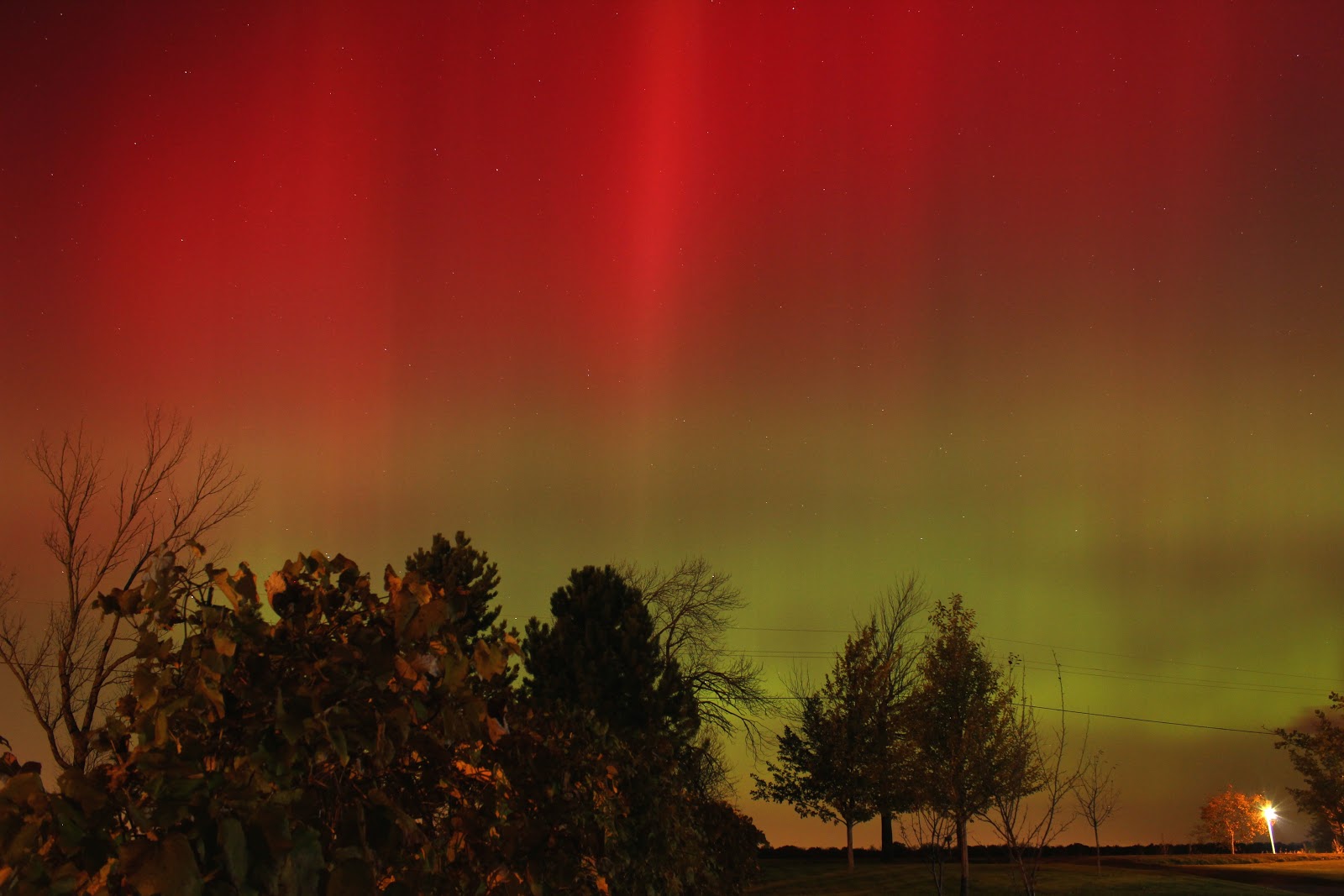
October 24th, 2011: Auroras return to Niagara, big time!
I received a call from one of my astronomy friends, letting me know he noticed a slight glow to the north. He shot a couple long exposures to confirm that he was seeing Auroras. Then he grabbed his phone and started calling RASC club members with cameras. I was lucky enough to be on his list. I grabbed my tripod&camera and ran outside and started shooting 18 second exposures at 400 ISO. Over the next hour the display went from dim to amazing!!! It was incredible! These images were taken at the peak:
| Psalm 19:1-2 The heavens proclaim the glory of God. The skies display His craftsmanship. Day after day they continue to speak; Night after night they make Him known. NLT |
Subscribe to:
Posts (Atom)